
I have a strong memory of visiting Melbourne as a teenager from country NSW. My dad and I were standing in Bourke St mall looking up at the tall buildings around us, and I remember him saying something along the lines of: “they sure spent alot of time decorating them with fancy, useless c%@p”. He was partly right – you could definitely see the huge amount of work and care chiselled into the raw stone. My father was a very practical man with an engineer mindset. Buildings were for working in, living, sleeping. For keeping the inside in and the outside out.
I silently disagreed with him though, having some innate appreciation for the artistry in these embellishments, but no real understanding to voice an opinion. I still liked looking at the older buildings compared to the more practical glass and steel monoliths. Those older buildings are rare and precious because today less time and money is spent to embellish our world.
Now ...
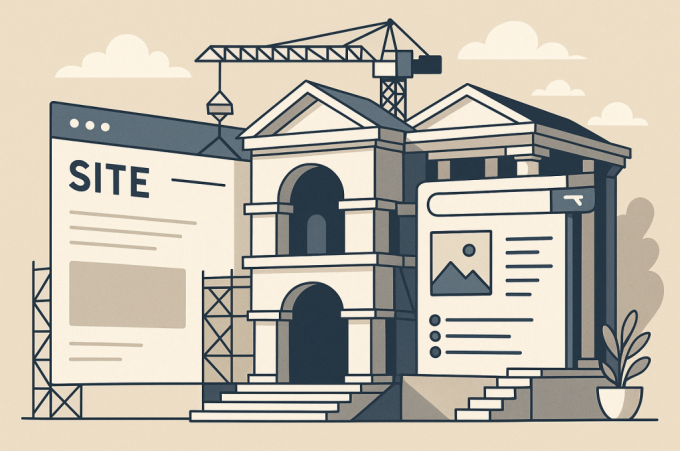
Fast forward to today, and virtual shopfronts & websites augment (or even replace) the physical malls and buildings. And as we spend an increasing amount of time online with much content competing for our attention… the best websites should (we are told) be pleasant to look at and a joy to experience. There is a whole industry built around making websites beautiful, from the technology investment in cascading style sheets (CSS) to social influencers posting their latest advice on what’s on trend and what has become outdated (with much the same gusto as interior designers telling us to buy the latest cloud sofas).
But does a website need to be pretty ? Does a button really need a cool hover effect, when the shape and/or cursor already indicates it is clickable ? Like those old buildings with their artfully crafted scroll-work and cornices, do we really need so much time and effort spent on making a site appealing for such a fleeting moment.
Soon...
Fast forward again to a not distant future and the search engines and Artificial intelligence will drastically change how (or even if) we find web content. Search engine intermediaries already handle our search, summarise our results, and present us with exactly what we asked for, along with helpful functions (eg like booking a restaurant) without ever leaving the search page. If most of our online experiences become filtered through algorithmic lenses or conversational interfaces, then the concept of a website as a crafted, visual space might fade away entirely — replaced by machine-assembled snippets and AI-generated interfaces.
In a sense, we could be entering a new “glass and steel” era of the internet — one where functionality and efficiency dominate, and the ornate scroll-work of digital design is deemed unnecessary. Pages that once invited exploration or reflected the personality of their creators may become flattened into utilitarian data feeds optimised for machines rather than people.
And yet...
Part of me believes that, just as those old Melbourne buildings still stand proudly among the modern towers, a new kind of digital craftsmanship will endure. Whether that means beautifully written content, human-centred design, or small creative touches that remind us someone cared — I think there will always be room for beauty, even when it’s not strictly “useful.”
As a small example, consider a business logo. From a machines’ perspective it serves no purpose whatsoever. However that small element of graphic design implies so much to us humans. The right logo can signal certain brand values – circles suggest unity and inclusiveness, squares imply stability, triangles convey motion and ambition. That subtle artistry that reminds us we’re not just building things to work, but to mean something.
So...
Why does it matter ? The internet is a vast network of code and content. It is arguably the largest engineering feat in human history. Bigger than the pyramids, more complex than any city ever built, it connects nearly every corner of our world. Like the pyramids, it’s a monument to what humanity can create. If this is our modern monument, it’s worth asking: will it endure as something merely functional, or will we also shape it to be beautiful. Can it be a reflection of our imagination, not just of our intelligence ?
Because in the end, what others see as decoration, I’ve come to see as devotion — evidence that someone, somewhere, believed the world deserved to be more than merely practical.